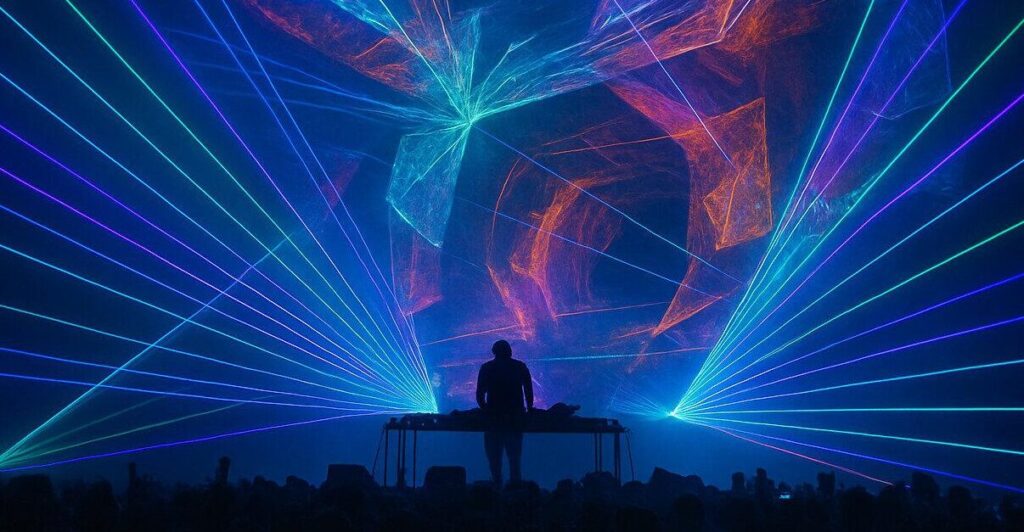
Live Music is becoming more interactive
Laser and projection mapping in live music are transforming the way audiences engage with performances. Creating visual spectacles that match the scale and energy of the sound. With cutting-edge tools and a growing creative appetite from artists and fans alike. This fusion of light and music has become one of the most exciting innovations in the industry.
From headline festivals to immersive indoor shows, these technologies are redefining what a live performance can be. Artists like Gareth Emery and projects like Glastonbury’s IICON stage are showing just how far this art form can go. But it’s not just about grandeur. It’s also about storytelling, emotion, and creating memories that go far beyond the music itself.
Precision Light Shows: The Rise of Laser Mapping
Laser mapping uses powerful, computer-controlled beams of light to create geometric patterns. Immersive environments and kinetic visual displays that respond in real-time to music. For live audiences, the result is often breathtaking. These lasers don’t just flicker with colour. They ripple, pulse, and sweep in perfect sync with kick drums, vocals, and drops. Artists like Gareth Emery have turned this into a core element of their shows, as seen in his LSR CITY experience. Where lasers aren’t just an effect—they’re part of the narrative.
These shows often feature hundreds of precision-mapped beams that transform stages into evolving digital sculptures. Companies like KVANT Lasers and NFI Laser are leading the charge with high-powered setups that push what’s possible onstage. What makes laser mapping especially effective is its ability to fill large spaces with energy. From expansive festival grounds to intimate club venues, this technology adapts well across scales. And with increasingly eco-friendly lasers and modular systems, it’s becoming more accessible even to mid-tier events and tours.
Animated Architecture: Projection Mapping in Music
Projection mapping goes one step further by turning 3D surfaces—walls, sculptures, buildings—into dynamic visual canvases. Unlike traditional screens, this technique lets artists manipulate physical environments to fit their performance. A flat wall might become a crashing wave or a pulsating grid of light, while a custom stage structure can appear to melt, explode, or dance in real-time. Glastonbury’s Block9 stage, IICON, is one of the most high-profile examples. Designed as a 20-metre-tall sculpted head, its surface becomes the medium for a barrage of mind-bending 360-degree projections.
With the addition of spatial audio, the experience becomes fully immersive—a light show with narrative depth and emotional power. These setups often rely on powerful projectors like the Christie Griffyn 4K50-RGB, capable of throwing vivid images across vast distances without losing clarity. Software like MadMapper and Resolume Arena enables show designers to synchronise projections with setlists, lighting and even pyrotechnics. At festivals like Electric Forest, projection mapping turns the natural environment into a storytelling tool. Forest trees become canvases. Hidden installations surprise passersby with animated visuals and responsive sounds. The vibe becomes dreamlike—like stepping into another world built entirely from art and rhythm.
Immersion and Interaction: Blurring the Audience Divide
One of the most exciting elements of both technologies is how they foster a new kind of audience interaction. Live music is no longer just seen and heard—it’s experienced. In some shows, sensors or mobile apps allow crowd members to influence visuals in real-time. At Cercle Odyssey, audiences were surrounded by 360-degree projections that felt like stepping into the artist’s imagination. These events push beyond entertainment into the realm of art installation.
Experiences like Genesis at London’s Swiss Church or Cercle’s performances in natural landscapes show that projection and laser mapping aren’t just effects. They’re a medium and tell stories. They tap into emotional layers that music alone might not reach. The line between artist and audience continues to blur. As AR and XR technology advance, expect even more layers of interactive immersion—from phone-activated overlays to full metaverse integrations. Coachella’s experiments with AR visuals are early signs of where this is heading: a future where live music becomes a shared, augmented experience
Creative Tools Behind the Magic
Bringing these spectacles to life requires serious tech. Most projection-mapped performances rely on multi-output media servers, ultra-bright projectors and pixel-precise calibration tools. Lasers, meanwhile, use DMX and ILDA protocols to sync with lighting rigs and music cues. Tools like TouchDesigner, Notch, and Resolume are popular in the live music visual scene. Many designers work alongside VJs, lighting techs, and stage architects to create integrated experiences where visuals evolve naturally with the performance.
What’s encouraging is the increasing accessibility of these tools. As tech prices drop and software becomes more intuitive, more artists can now experiment with high-quality mapping and laser effects—whether in a nightclub, warehouse show or open-air festival.
Looking Ahead: What’s Next in Laser and Projection Mapping
Laser and projection mapping in the live music industry is moving fast. We’re entering an era where visual storytelling is just as central as the music itself. With the rise of AI-generated visuals, live-rendered 3D art, and sustainable staging, the potential is endless. Environmental concerns are also shaping the future. Projects like Cercle Odyssey are committed to reducing the carbon footprint of immersive shows by minimizing transport and using local tech partners. As fans become more conscious of impact, sustainability could become a new creative constraint—and spark innovation. For fans, these shows are more than entertainment. They’re moments of wonder. For artists, they’re a new frontier of expression. And for the industry, they represent a chance to redefine what live music can be in the digital age.
Other information..
For those interested in live event production.
Laser tech leaders like ER Lasers showcase the cutting edge of immersive show technology.
If you want to dive deeper into how technology is reshaping music, check out our piece on AI in the Music Industry, which explores the growing role of artificial intelligence in creative processes. For a glimpse at festival innovation, our coverage of the Glastonbury 2025 Pyramid Stage lineup highlights some of the most exciting performances and stage designs this year.
And if you’re following the electronic scene, don’t miss our detailed guide to Netsky’s August 2025 New Zealand tour, offering insights on the drum and bass titan’s upcoming shows.